Eszopiclone vs Zopiclone: Quick Answer
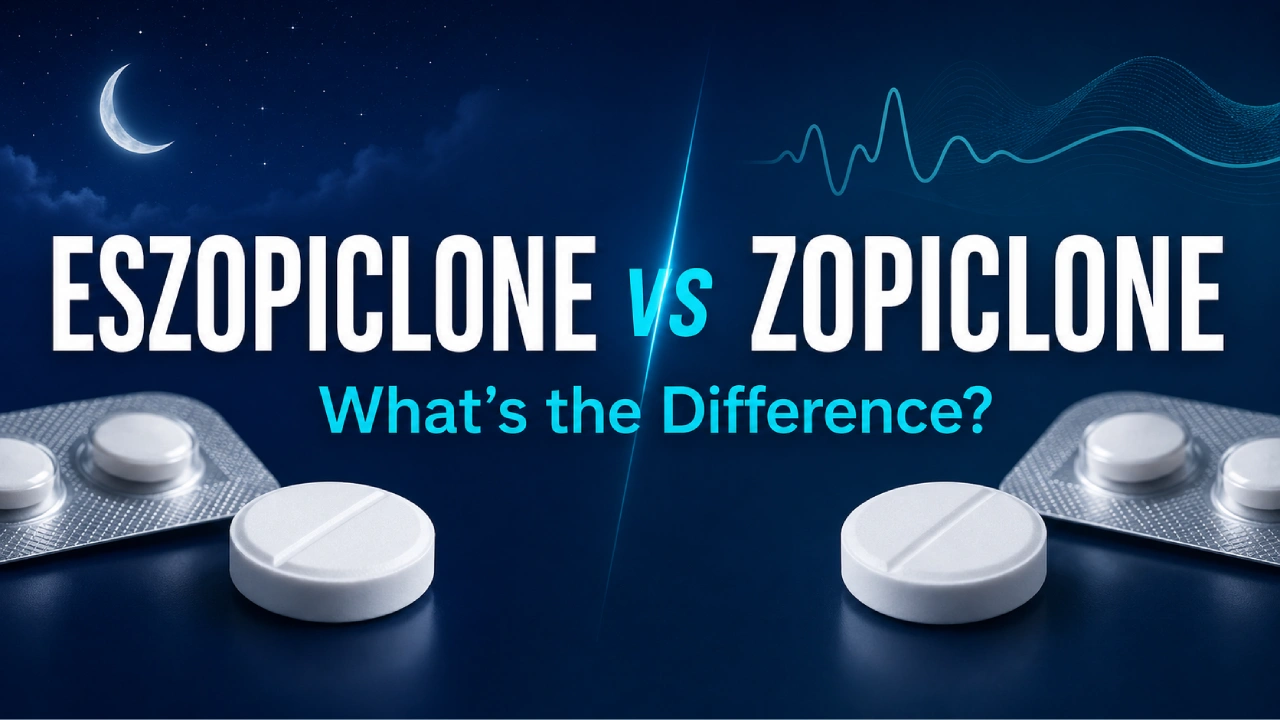
The main difference between eszopiclone and zopiclone is their chemical composition. Zopiclone contains a mixture of two mirror-image forms of the same molecule, while eszopiclone contains only the S-form, which is considered the principal active component.
Both medicines are non-benzodiazepine hypnotics, commonly called Z-drugs, and are prescribed to treat insomnia. However, they are not directly interchangeable milligram for milligram. They may also differ in approved dosages, treatment duration and availability depending on the country.
Eszopiclone vs Zopiclone Comparison
| Feature | Eszopiclone | Zopiclone |
|---|---|---|
| Drug class | Non-benzodiazepine hypnotic or Z-drug | Non-benzodiazepine hypnotic or Z-drug |
| Composition | S-enantiomer of zopiclone | Racemic mixture containing two enantiomers |
| Main use | Treatment of insomnia | Short-term treatment of insomnia |
| Common adult strengths | 1 mg, 2 mg and 3 mg | 3.75 mg and 7.5 mg |
| Typical time to peak level | Approximately one hour | Generally reached relatively quickly after taking |
| Approximate half-life | Around six hours | Commonly reported at approximately five hours |
| Availability | Commonly prescribed in the United States | More commonly prescribed in the UK and several other countries |
| Common side effect | Unpleasant or metallic taste | Bitter or metallic taste |
| Dependence risk | Yes | Yes |
| Prescription required | Yes | Yes |
Dosages shown here are general examples, not personal recommendations. Older adults and people with certain medical conditions may be prescribed lower doses.
What Is Eszopiclone?
Eszopiclone is a prescription sleeping medicine used for the treatment of insomnia. It may help people who have difficulty:
- Falling asleep
- Staying asleep during the night
- Returning to sleep after waking
- Getting enough sleep to function the following day
Eszopiclone is the S-enantiomer of zopiclone. An enantiomer is one of two molecular forms that are chemically similar but arranged differently in space.
The medicine enhances the activity of gamma-aminobutyric acid, or GABA, a chemical messenger that reduces activity in the central nervous system. This calming action can make it easier to sleep.
According to the US prescribing information, eszopiclone reaches its peak concentration in approximately one hour and has an elimination half-life of about six hours. A heavy or high-fat meal may delay its effect on sleep onset. DailyMed eszopiclone prescribing information
What Is Zopiclone?
Zopiclone is also a prescription Z-drug used to treat insomnia. It can be prescribed when sleeping difficulties significantly affect a person’s daily life.
Unlike eszopiclone, zopiclone contains both the S- and R-forms of the molecule. It is therefore described as a racemic mixture.
Zopiclone usually begins working within approximately 30 to 60 minutes. In the UK, it is normally prescribed for a short period—from a few days to a few weeks—and generally for no longer than four weeks because tolerance and dependence can develop. NHS guidance on zopiclone
What Is the Main Difference Between Eszopiclone and Zopiclone?
The primary difference is that eszopiclone contains only one active molecular form, whereas zopiclone contains two forms.
Think of the molecules as a pair of hands. A left hand and a right hand have similar parts but are arranged differently. Zopiclone contains both “hands,” while eszopiclone contains only one.
This chemical difference affects the strengths in which the medicines are supplied. It does not mean that the dose of one drug can be calculated simply by matching the number of milligrams on the packet.
Are eszopiclone and zopiclone the same medicine?
No. They are closely related but are not identical formulations. Eszopiclone is derived from one of zopiclone’s two molecular forms. Each medicine has its own approved doses and prescribing information.
Is eszopiclone stronger than zopiclone?
It is misleading to describe one as universally “stronger.” Eszopiclone contains the main active S-enantiomer, so it is prescribed at lower numerical doses. However, tablet strength alone does not establish that one medicine will produce a stronger or better effect in an individual.
A healthcare professional considers factors such as:
- The type and severity of insomnia
- Age
- Liver function
- Other medicines
- History of substance misuse
- Previous reactions to sleeping tablets
- Risk of next-day impairment
Which One Works Better for Insomnia?
Both drugs can help reduce the time needed to fall asleep and may improve sleep maintenance. Whether one works better depends on the individual, the nature of the sleep problem and the approved treatment practices in their country.
Eszopiclone may be prescribed for sleep-onset or sleep-maintenance insomnia. Zopiclone is also used for difficulty falling asleep, waking during the night or waking too early.
Neither medicine addresses every possible cause of poor sleep. Insomnia can be associated with anxiety, depression, pain, sleep apnoea, restless legs syndrome, shift work, medication use or lifestyle factors. Treating an underlying cause may be more important than changing sleeping pills.
For persistent insomnia, cognitive behavioural therapy for insomnia (CBT-I) is often considered an important treatment because it targets the thoughts and behaviours that maintain sleep difficulties.
Dosage Differences
Eszopiclone commonly comes in 1 mg, 2 mg and 3 mg tablets. Zopiclone is commonly available as 3.75 mg and 7.5 mg tablets in countries where it is licensed.
These numbers should not be used to perform a self-directed conversion. Eszopiclone and zopiclone are not interchangeable on a milligram-for-milligram basis.
The appropriate dose may be lower for:
- Older adults
- People with severe liver impairment
- People taking medicines that affect drug metabolism
- Individuals vulnerable to falls or confusion
- People who experience significant next-day drowsiness
Never take an extra dose during the same night unless a qualified prescriber has specifically instructed you to do so.
Side Effects of Eszopiclone and Zopiclone
Because the medicines are closely related and act in similar ways, many of their side effects overlap.
Common side effects
Possible side effects include:
- Bitter, metallic or unpleasant taste
- Dry mouth
- Headache
- Dizziness
- Daytime drowsiness
- Reduced concentration
- Memory problems
- Nausea
- Unusual dreams
Taste disturbance is especially well known with this group of medicines. It can occur with either medication and does not necessarily mean that the medicine is unsafe or ineffective.
Serious side effects
Seek urgent medical assistance if a person experiences:
- Difficulty breathing
- Swelling of the face, lips, tongue or throat
- Severe confusion
- Hallucinations
- Significant mood or behavioural changes
- Thoughts of self-harm
- A serious fall or injury
- Unusual behaviour while not fully awake
Both medicines have been associated with complex sleep behaviours, such as sleepwalking, preparing food, making phone calls or driving while not fully awake. A person may have no memory of the event afterwards. Eszopiclone’s US label carries a boxed warning about complex sleep behaviours. DailyMed Lunesta label
Contact the prescriber promptly if any unusual night-time activity occurs.
Dependence, Tolerance and Withdrawal
Both eszopiclone and zopiclone can lead to tolerance, physical dependence and misuse. Tolerance means the original dose may appear less effective over time. Dependence means withdrawal symptoms can occur if the medicine is suddenly stopped.
Possible withdrawal symptoms include:
- Rebound insomnia
- Anxiety
- Irritability
- Sweating
- Tremor
- Palpitations
- Nausea
- Restlessness
Rarely, more severe withdrawal effects may occur.
In January 2026, the UK Medicines and Healthcare products Regulatory Agency announced stronger addiction, dependence and withdrawal warnings for Z-drugs and several related medicines. It emphasized that these problems can sometimes occur even during short-term use at recommended doses. MHRA drug-safety update
Do not stop regular or long-term treatment suddenly without medical advice. A clinician may recommend reducing the dose gradually.
Also Read: Insomnia vs. Sleep Deprivation: Know the Difference
Can You Take Eszopiclone and Zopiclone Together?
They should not normally be taken together. Because they are closely related sedative medicines, combining them may increase the risk of:
- Excessive sedation
- Confusion
- Falls
- Memory impairment
- Abnormal sleep behaviours
- Slowed or difficult breathing
- Next-day driving impairment
Do not combine either drug with another sleeping tablet unless the combination has been explicitly prescribed.
Alcohol and Other Drug Interactions
Avoid alcohol when taking eszopiclone or zopiclone. Alcohol can intensify sedation, impaired coordination, memory problems and abnormal sleep behaviours.
Extra caution is necessary with:
- Opioid pain medicines
- Benzodiazepines
- Sedating antihistamines
- Antipsychotic medicines
- Some antidepressants
- Antiseizure medicines
- Muscle relaxants
- Other sleep aids
- Medicines that alter liver-enzyme activity
Combining a Z-drug with opioids or other central nervous system depressants can increase the risk of profound sedation and respiratory depression.
Always tell your doctor or pharmacist about prescription medicines, over-the-counter products, supplements and recreational substances you use.
Next-Day Drowsiness and Driving
Either medicine can affect alertness the next morning, even if the user feels awake. Risk may be higher when:
- The dose is too high
- The medicine is taken late at night
- Fewer than seven to eight hours remain for sleep
- It is combined with alcohol or another sedative
- The person is older
- Drug clearance is reduced
- The medicine is taken more frequently than prescribed
Do not drive, cycle, use machinery or perform hazardous work if you feel sleepy, dizzy, mentally slowed or unable to concentrate. Follow the medicine’s local prescribing information and your clinician’s instructions.
Who Should Speak to a Doctor Before Taking These Medicines?
A detailed medical review is especially important for people with:
- Sleep apnoea or breathing disorders
- Severe liver disease
- Myasthenia gravis
- Depression or suicidal thoughts
- A history of alcohol or drug dependence
- Previous sleepwalking or complex sleep behaviours
- Pregnancy or breastfeeding
- Frequent falls
- Multiple sedating medications
Older adults may be more sensitive to confusion, poor balance and next-day impairment.
Can You Switch from Zopiclone to Eszopiclone?
A switch may be possible, but it should be planned by a prescriber. The drugs have different formulations and approved dose ranges, so a direct self-calculated conversion may be unsafe.
Before switching, the clinician may review:
- How long the current medicine has been used
- Current dose and frequency
- Whether tolerance has developed
- Side effects
- Other sedatives or alcohol use
- The reason treatment is being changed
- Whether gradual dose reduction is required
Never use leftover tablets or medicines prescribed to someone else.
Eszopiclone vs Zopiclone: Which Is Safer?
Neither drug is automatically safer for everyone. Their safety depends on the dose, duration, other medicines, health conditions and how closely prescribing instructions are followed.
The safest approach is generally to:
- Use the lowest effective prescribed dose.
- Take it only when enough time remains for a full night’s sleep.
- Avoid alcohol and unapproved sedatives.
- Never take more than prescribed.
- Report sleepwalking or unusual behaviour immediately.
- Review ongoing use regularly with a healthcare professional.
- Never buy prescription sleeping pills from an unverified website.
Frequently Asked Questions
Is eszopiclone just purified zopiclone?
Eszopiclone contains only the S-enantiomer found in zopiclone, whereas zopiclone contains both S- and R-enantiomers. Calling it “purified zopiclone” is an oversimplification because it is regulated and prescribed as a separate medicine.
Are zopiclone and eszopiclone benzodiazepines?
No. They are non-benzodiazepine hypnotics known as Z-drugs. However, they act on GABA-related receptor systems and can cause effects similar to benzodiazepines, including sedation, dependence and withdrawal.
How quickly do they work?
Both are relatively fast-acting. Zopiclone generally begins working within 30 to 60 minutes, while eszopiclone reaches peak blood levels in approximately one hour. Individual response varies.
Can these medicines be used every night?
Only as directed by a prescriber. Zopiclone is generally intended for short-term treatment. The appropriate duration of eszopiclone treatment depends on local approval, response and regular clinical reassessment.
Which drug causes a metallic taste?
Both can cause an unpleasant, bitter or metallic taste. This is a well-recognized side effect of zopiclone-related medicines.
Can I stop taking zopiclone or eszopiclone suddenly?
Do not suddenly stop regular or prolonged treatment without speaking to a healthcare professional. Gradual dose reduction may be necessary to reduce withdrawal and rebound insomnia.
Is zopiclone available in the United States?
Zopiclone itself is not approved for routine prescription use in the United States. Eszopiclone is available there under generic names and the brand name Lunesta. Availability differs by country.
Is eszopiclone available in the UK?
Availability and routine prescribing differ between healthcare systems. Zopiclone is the more commonly recognized licensed formulation in the UK. Patients should check with a UK prescriber or pharmacist rather than purchasing medication elsewhere.
The Bottom Line
Eszopiclone and zopiclone are closely related prescription sleeping medicines, but they are not identical. Zopiclone contains two molecular forms, while eszopiclone contains only the active S-enantiomer. They also differ in available strengths, licensing, treatment practices and regional availability.
Both may help with insomnia, but both can cause next-day impairment, unpleasant taste, dependence, withdrawal and potentially dangerous complex sleep behaviours. The choice should be made with a qualified healthcare professional based on the individual’s symptoms, medical history and other medications.
For long-lasting sleep problems, ask a healthcare professional about identifying the underlying cause and whether CBT-I or other non-drug treatments may be appropriate.
Also Read: What Are the Common Brands of Zopiclone Available in the UK?