What Is the 4-7-8 Breathing Technique?
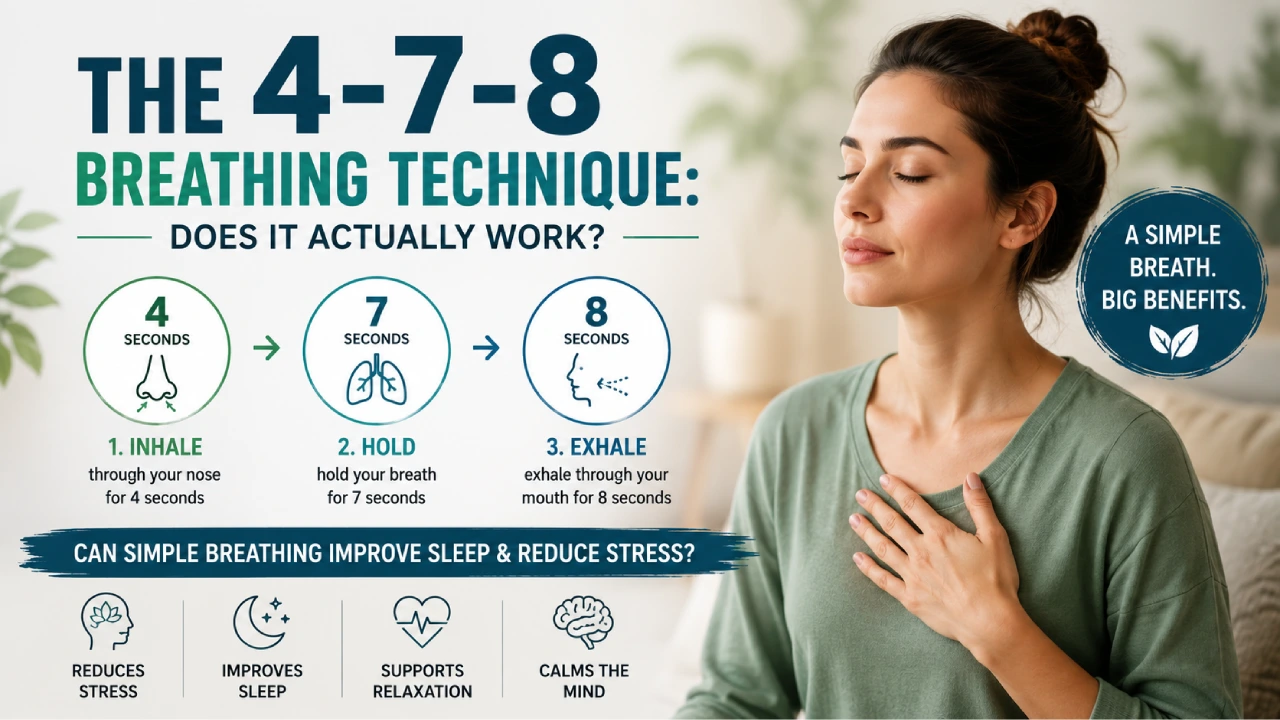
The 4-7-8 breathing technique is a structured breathing pattern based on pranayama, an ancient yogic practice of breath control. It was popularised by Dr. Andrew Weil, a Harvard-trained physician and founder of the Andrew Weil Center for Integrative Medicine, who describes it as a “natural tranquilizer for the nervous system.”
Table
| Phase | Duration | Action |
|---|---|---|
| Inhale | 4 seconds | Breathe in quietly through your nose |
| Hold | 7 seconds | Hold your breath |
| Exhale | 8 seconds | Exhale forcefully through your mouth with a “whoosh” sound |
The key is maintaining the 4:7:8 ratio, not the exact seconds. If you’re a beginner, you can scale it down (e.g., 2-3.5-4) and still get benefits.
The Science Behind 4-7-8 Breathing: What Research Actually Shows
1. Reduces Anxiety (Backed by Clinical Trials)
A 2023 randomised controlled trial published in Obesity Surgery found that the 4-7-8 breathing technique significantly reduced state anxiety in patients recovering from bariatric surgery compared to both a control group and a general deep breathing group.
Another 2025 scoping review analysed 15 studies published between 2013 and 2024 and concluded that 4-7-8 breathing consistently demonstrated effectiveness in reducing stress and anxiety across diverse clinical populations, including ICU patients and those with chronic degenerative diseases.
2. Improves Heart Rate Variability and Blood Pressure
- Significant decreases in low-frequency power and the low-frequency to high-frequency ratio — indicating reduced sympathetic (stress) activity
- Increased high-frequency power in normalised units, reflecting greater parasympathetic (rest-and-digest) activity
Lowered heart rate and blood pressure in almost all participants
3. May Help You Fall Asleep Faster
While no large-scale clinical trial has specifically tested 4-7-8 breathing as a standalone insomnia treatment, the mechanism is well-understood. By activating the parasympathetic nervous system via the vagus nerve, the technique triggers what Harvard cardiologist Herbert Benson called the “relaxation response” — essentially the opposite of your body’s fight-or-flight mode.
A 2023 review noted that even just 5 minutes of slow, controlled breathing can significantly reduce stress and anxiety — key contributors to sleeplessness.
4. Enhances Emotional Regulation
Research from 2023 indicates that controlled breathing techniques like 4-7-8 can enhance your ability to notice and regulate emotions by reducing activity in the anterior insula — the brain region responsible for processing emotional responses to experiences.
How Does 4-7-8 Breathing Actually Work?
Activates the Parasympathetic Nervous System
- Sympathetic nervous system — fight or flight (stress, alertness, danger response)
- Parasympathetic nervous system — rest and digest (relaxation, recovery, sleep)
The extended exhale in 4-7-8 breathing (8 seconds) is particularly powerful because exhalation is parasympathetic-dominant. The longer you exhale, the more you stimulate your vagus nerve — the main highway of your rest-and-digest system.
Increases Oxygen-Carbon Dioxide Exchange
Forces Mindfulness
How to Do the 4-7-8 Breathing Technique (Step-by-Step)
Preparation
- Find a comfortable position — sit with your back straight, or lie down if using this for sleep
- Place the tip of your tongue against the ridge of tissue behind your upper front teeth
- Keep your tongue there throughout the entire exercise
The Cycle
- Exhale completely through your mouth, making a whoosh sound
- Close your mouth and inhale quietly through your nose for a count of 4
- Hold your breath for a count of 7
- Exhale completely through your mouth, making a whoosh sound, for a count of 8
- This completes one breath. Repeat the cycle 3 more times for a total of 4 breaths
Important Tips
- Start small: Only do 4 cycles at first. As you get comfortable, you can work up to 8 cycles
- You may feel lightheaded initially — this is normal and passes quickly
- The ratio matters more than the seconds: If you can’t hold for 7, try 2-3.5-4
Practice twice daily for best results, even when you’re not stressed
4-7-8 Breathing vs. Other Techniques
Table
| Technique | Pattern | Best For | Evidence Level |
|---|---|---|---|
| 4-7-8 Breathing | 4-7-8 | Anxiety, sleep onset | Moderate (growing) |
| Box Breathing | 4-4-4-4 | Focus, performance under pressure | Moderate |
| Alternate Nostril Breathing | Alternating nostrils | Balance, mental clarity | Moderate |
| 6 Breaths/Minute | 5-5 or 5-7 | Heart rate variability | Strong |
A 2025 study comparing 4-7-8, box breathing, and 6 breaths-per-minute found that 6 bpm breathing was slightly more effective at increasing HRV, but 4-7-8 still showed significant benefits with a lower risk of discomfort for beginners.
Who Should Try 4-7-8 Breathing?
- Struggle with mild insomnia due to racing thoughts
- Experience anxiety before bed or during stressful situations
- Want a natural alternative to sleep medication
- Need a quick tool for public speaking nerves or pre-meeting jitters
- Have high blood pressure and want lifestyle interventions
When to Be Cautious
- If you feel severely lightheaded, stop and breathe normally
- People with respiratory conditions (COPD, severe asthma) should consult a doctor first
If you have chronic insomnia lasting more than 3 months, see a sleep specialist — 4-7-8 is a tool, not a cure for underlying sleep disorders
The Bottom Line: Does 4-7-8 Breathing Actually Work?
- Reduces anxiety in clinical settings (randomised controlled trials)
- Lowers blood pressure and heart rate
- Improves heart rate variability (a marker of stress resilience)
- Activates the parasympathetic nervous system through vagus nerve stimulation
As Dr. Maryanna Klatt, Director of the Center for Integrative Health at Ohio State University, notes: “Using the 4-7-8 breath can activate the vagus nerve, relaxing your mind and various organs throughout the body.”
Ready to Try It Tonight?
- Put down your phone (after finishing this article, of course)
- Lie on your back, tongue against the roof of your mouth
- Do 4 cycles of 4-7-8 breathing
- If your mind wanders, gently return to counting
- Repeat up to 8 cycles if needed